
By Birth & Baby University · Last updated: October 2026 · 7 min read
Online and in-person doula trainings both exist, both can lead to certification, and people argue about them with more confidence than the evidence allows. A fair comparison separates three things: what the learner can know after the course, what the learner can do with their hands and voice, and what the learner can prove to a certifier or payer. The research that exists speaks mostly to the first, a little to the second, and not at all to doulas specifically.
Key takeaways
Quick answer: for the knowledge part of training, the best evidence from other health fields suggests well-designed online learning performs about as well as traditional teaching, with a lot of uncertainty. For hands-on skills and for confidence in real situations, live practice and feedback matter, and a blended or live-virtual format with real-world practice may serve many learners well. No study I found compares online and in-person doula training directly.
- A Cochrane review of e-learning for licensed health professionals (Vaona and colleagues, 2018; 16 trials, 5,679 participants) concluded that e-learning may make little or no difference compared with traditional learning for knowledge, and that effects on skills were uncertain.
- A systematic review and meta-analysis of blended learning in health professions (Liu and colleagues, 2016; 56 studies) found blended learning to be more effective than or at least as effective as non-blended instruction for knowledge acquisition, with very large heterogeneity.
- In a survey of 252 U.S. doulas (Hall and colleagues, 2025), respondents preferred in-person training built into foundational workshops for emotional support skills.
- Certifying organizations differ in what formats they accept. What counts as completing the training is set by the certifier or payer, not by the format’s reputation.
The formats, as certifiers define them
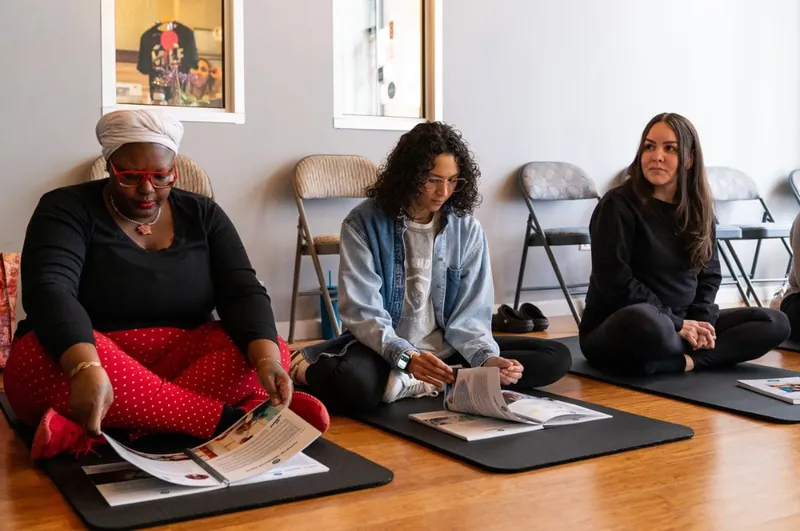
DONA International lists three workshop types on its training workshops page (read October 2026): virtual, where 100 percent of requirements are met virtually with a DONA-approved trainer in a live workshop; in-person; and hybrid, which has virtual and in-person components taught by the same trainer, and is explicitly not an in-person class with a streaming video feed. CAPPA’s labor doula page describes its 18-hour training as live in person or live online. So for these two organizations, “online” most often means live, instructor-led virtual teaching, which is different from a self-paced video course. Self-paced programs exist too, and a certifier or payer may or may not accept them. Check before you enroll.
Certification is not just the workshop. DONA requires continuous in-person labor support at three births for its birth doula certification (requirements), and CAPPA’s postpartum track allows some, but not all, of its three required families to be served with virtual support, with in-person support requiring at least 15 hours per family and virtual support at least 5 (requirements). Whatever format you train in, the real-world practice requirement is where you earn certification.
What the research says
Knowledge. The Cochrane review by Vaona and colleagues (2018) assessed e-learning compared with traditional learning in licensed health professionals. Across 16 randomized trials, low-certainty evidence suggested e-learning may make little or no difference to knowledge, and the authors cautioned that general claims that e-learning is inherently more effective than traditional learning may be misleading. The same review found it uncertain whether e-learning improves or reduces skills (very low-certainty evidence). The authors could not complete a meaningful risk-of-bias assessment for most criteria because of poor reporting.
Blended formats. Liu and colleagues (2016) combined 56 studies of blended learning, which mixes face-to-face and online elements, and found it more effective than or at least as effective as non-blended instruction for knowledge acquisition. They flagged very large heterogeneity and advised caution.
Practical skills. A 2024 meta-analysis of online teaching of practical skills to nursing students (Li and colleagues, 2024; 18 studies, 2,274 students) concluded that online education could improve knowledge, skills, confidence and satisfaction, and was superior to traditional classroom instruction on the outcomes pooled. The studies were of nursing students, a different population with different skills, and results from education research are not guaranteed to transfer.
Doula-specific signals. Hall and colleagues (2025) surveyed 252 U.S. birth, postpartum and community doulas about emotional support training. They overwhelmingly wanted more of it and preferred in-person training incorporated into foundational workshops. A qualitative study (Semadeni and colleagues, 2025) described cost, time and access as barriers to training and recommended removing logistical barriers. These are views, not outcomes, but they point to a real trade-off: in-person formats can feel better for relational skills, and online formats can remove travel and scheduling barriers.
An honest summary of the evidence
- Established: knowledge can be taught well in several formats, and format alone is not a reliable predictor of how much learners know.
- Uncertain: how format affects skills such as supporting labor positions, giving counterpressure, or having difficult conversations. Evidence comes from other professions and is mixed or low certainty.
- Not studied, as far as I found: whether doulas trained online or in person differ in client outcomes, competence ratings or longevity. I searched the research databases used for this article and found no study that tested this.
The differences that probably matter most are not the format label, but the quality of the instruction, the opportunities to practice, and what follows training.
Putting it into practice: choosing between formats
- Start with acceptance. Does your certifier accept the format? Does your state’s Medicaid agency, your agency employer or your hospital program? Ask in writing.
- Match the format to the skill. For comfort measures and positions, look for live demonstration and feedback, whether in a room or on camera, with real practice time. For information-heavy content, a well-paced online format may suit many learners.
- Ask what live contact you get. Direct access to a trainer, cohort discussion, case review and role-play matter more than whether the screen is in your living room.
- Be honest about your learning style and life. Travel, childcare, work schedules and cost are legitimate constraints, and the doulas surveyed in the research said so.
- Plan the practice requirement before you start. You will need real births or families wherever you train. Think about where those will come from.
- Supplement. If you train online and want more hands-on feedback, shadowing or mentoring with an experienced doula can fill the gap, within your certifier’s rules (DONA, for instance, does not accept births attended as a buddy for submission).
When this guidance may not apply
The studies reviewed here concern licensed clinicians and students in other health professions, not doulas, and their findings do not carry over automatically. Certifier rules about acceptable formats have changed over time and may change again.
The bottom line
Choose the format your certifier and payer accept, that gives you real practice with feedback, and that you can actually complete. For many people that will be a live online or hybrid program. For others it will be an in-person workshop. The label matters less than the teaching and the practice behind it.
Birth & Baby University’s For Doulas page describes its online, self-paced birth and postpartum doula training alongside recertification and mentorship for doulas building experience. As with any program, confirm that its format meets your certifier’s, employer’s or state’s requirements before you enroll.
This article is for professional education. It is not medical, legal or tax advice. Check the standards of your certifying organization and the rules where you work.
Sources and further reading
- Vaona A, et al. E-learning for health professionals. Cochrane Database of Systematic Reviews (2018). Read the source
- Liu Q, et al. The effectiveness of blended learning in health professions: systematic review and meta-analysis. Journal of Medical Internet Research (2016). Read the source
- Li A, et al. Development and effectiveness of online teaching on practical skills among nursing students: a systematic review and meta-analysis. Nurse Education in Practice (2024). Read the source
- Hall EM, et al. Doula support for perinatal mental health needs: perspectives on training and practice. Midwifery (2025). Read the source
- Semadeni C, et al. “We don’t just want doulas. We want good doulas.” Social Work in Mental Health (2025). Read the source
- DONA International. Training Workshops, and Birth Doula Certification (read October 2026). Workshops · Certification
- CAPPA. Labor Doula (CLD) and Postpartum Doula (CPD) certification pages (read October 2026). CLD · CPD
More for professionals: the Professionals Blog.



Leave a Reply