

By Birth & Baby University · Last updated: October 2026 · 6 min read
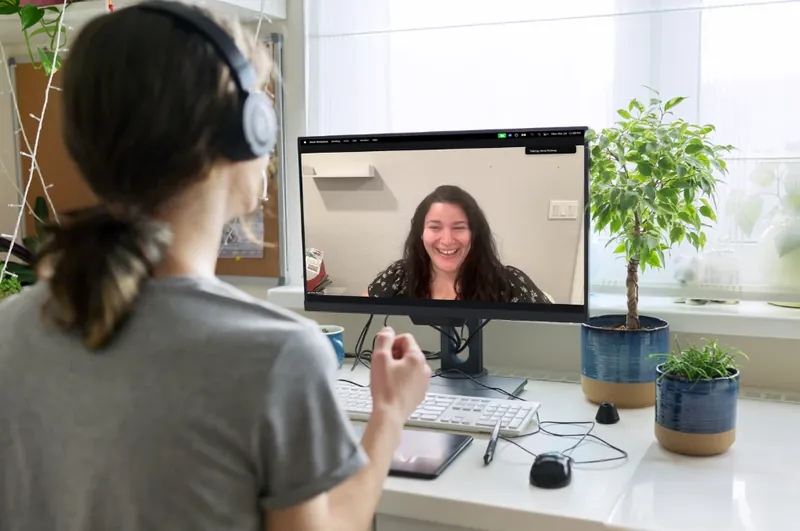
Many families now learn about birth from a screen. Online childbirth classes, apps, short videos and recorded sessions are easier to fit into a life with work, children and distance, and for some people they are the only classes available. The promise is access to evidence-based information. The research asks two questions: do digital classes change anything that matters, and do they reach everyone who needs them? This article summarizes what the studies show, where the results disagree, and how doulas and educators can use digital education to support families, not to replace the human parts of preparation.
Key takeaways
Quick answer: digital childbirth education improves convenience and can reach people who would not attend an in-person class. The best available pooled evidence does not show clear effects on depression, anxiety, fear of childbirth or self-efficacy, though it is highly heterogeneous. Women also describe a digital divide that can leave vulnerable families out. Quality of content, not the format, is what determines whether the information is evidence-based.
- A 2026 meta-analysis of 12 studies with 4,982 participants found no statistically significant effects of online antenatal education on depression, anxiety or self-efficacy, and a reduction in fear of childbirth that did not reach significance (p = 0.051), with very high heterogeneity.
- A three-arm randomized trial of an online childbirth course with 125 women found a trend toward higher self-efficacy but no significant group differences, and birth-related PTSD scores were, unexpectedly, higher in the intervention group.
- In a Canadian cohort of 863 first-time pregnant people, exposure to breastfeeding information from online education, alone or together with in-person classes, was associated with breastfeeding intentions and initiation.
- An integrative review of 12 articles found a marked digital divide in access to online antenatal education.

What the pooled evidence shows
Bai and colleagues (2026) searched six databases through March 2026 and included 12 randomized and observational studies of digital antenatal interventions. Pooled effects were not statistically significant for maternal depression, anxiety or self-efficacy, a reduction in fear of childbirth narrowly missed significance, and there was no significant association with small-for-gestational-age birth. Heterogeneity was substantial, with I-squared values above 85 percent for most outcomes. The authors say this means the pooled estimates are exploratory and that clinically meaningful effects for specific intervention types cannot be ruled out. In plain terms, the evidence does not show that online classes change these outcomes, and it does not show that they do not.
The single trial that illustrates this uncertainty is Frankham and colleagues (2024). It randomized 125 Australian women to an online childbirth course, a passive control or an active control that read birth stories. There was no significant group difference in childbirth self-efficacy, though scores trended higher in the online group. Birth-related PTSD symptoms and mother-infant relationship scores did not differ significantly at six weeks or six months, and the abstract reports that PTSD scores were higher in the intervention group, which the authors call paradoxical and attribute possibly to external factors. One small trial of one course cannot settle the question, but it is a reminder that “education” is not automatically protective.
Where digital education shows promise
Ponte and colleagues (2026) followed 863 first-time pregnant people in Québec, of whom 358 completed questionnaires, and compared those who used face-to-face group classes, asynchronous online classes, both, or standard prenatal care only. When breastfeeding content was included, exposure from the online option alone, or from both services, was associated with breastfeeding intentions and initiation. No education service was associated with self-efficacy or exclusivity. The authors describe the services as complementary. It is an observational study based on self-reported use, and people chose their own services, so the associations may reflect who chose what.
Who gets left out
Whitworth and colleagues (2024) reviewed 12 studies of women’s experiences with online antenatal education. They found tension between flexibility and social connection, and a marked digital divide that places vulnerable women at risk of continuing inequity. They recommend e-health literacy frameworks so that online education is accessible, comprehensible and culturally responsive. The review is limited to published English-language research up to 2022 and to women’s experiences, not outcomes.
What “evidence-based” means for a digital class
The format does not make a class evidence-based. A class is only as good as its content, and families rarely can judge that themselves. Questions worth asking of any digital course, app or video series include:
- Are the sources named, dated and linked to professional guidelines, government agencies or peer-reviewed research?
- Does the class distinguish established evidence from emerging research or opinion, and say where research is mixed?
- Does it avoid absolute claims about interventions and outcomes?
- Who wrote and reviewed it, and when was it last updated?
- Does it tell families when to contact their care team and when to seek emergency care?
- Is it available in the languages and reading levels families need, and can people without fast internet use it?
What this means for doulas
- Use digital classes as a supplement. They can give clients flexible access to information. Doulas can add the human elements, such as questions, practice and emotional support.
- Review what you recommend. Before pointing clients to a course or app, check it against the questions above, and revisit it periodically.
- Ask about access. Check whether clients have a device, a reliable connection, privacy and time. Offer print or phone alternatives where needed.
- Do not promise outcomes. The evidence does not show that taking a class reduces cesareans, fear or distress. Present it as helping families prepare and understand options.
- Stay in scope. Education about options is within the doula’s informational role. Medical advice is not. Our article on supporting informed decision-making without medical advice covers the line.
Putting it into practice
- Build a short list of vetted digital resources for common topics, and note the date you last checked each.
- Offer clients a choice between an online option, an in-person class and a hybrid, and explain the trade-offs honestly.
- After a client takes a class, ask what they learned and what questions remain, without testing them.
- Check that materials are in the client’s language and at an accessible reading level.
- Read our related article on what research says about continuous labor support to keep education and support in perspective.
Limits and uncertainty
The sources are a heterogeneous meta-analysis of mixed designs, one small randomized trial of one course, an observational cohort from Canada and a review of experiences. Interventions differ widely, from apps to recorded courses to live online classes, so “digital” covers very different things. The evidence says little about information quality across the many products available.
The bottom line
Digital childbirth education widens access and convenience, and in some studies is associated with outcomes like breastfeeding intentions, but pooled evidence does not yet show consistent effects on mental health or self-efficacy, and a digital divide may leave out the families who most need information. The key to evidence-based learning online is the quality of the content and the human support around it.
Birth & Baby University’s For Doulas page outlines its online, self-paced birth and postpartum doula training, recertification and mentorship, for doulas who want to build education skills alongside hands-on support.
This article is for professional education. It is not medical, legal, financial or tax advice. Check the standards of your certifying organization and the rules where you work.
Sources and further reading
- Bai X, Song J, Zhang X. Online-based antenatal education and its effects on maternal mental health and selected neonatal outcomes: a systematic review and meta-analysis. BMC Public Health (2026). Read the source
- Frankham LJ, Thorsteinsson EB, Bartik W. Childbirth self-efficacy and birth related PTSD symptoms: an online childbirth education randomised controlled trial for mothers. BMC Pregnancy and Childbirth (2024). Read the source
- Ponte MV, Prud’homme A, Semenic S, et al. The effectiveness of online versus group prenatal education on breastfeeding determinants and outcomes in nulliparous women: a prospective cohort study. Journal of Midwifery & Women’s Health (2026). Read the source
- Whitworth K, Donnellan-Fernandez R, Fleet JA. Women’s experiences of online antenatal education: an integrative literature review. Journal of Advanced Nursing (2024). Read the source
More for professionals: the Professionals Blog.



Leave a Reply