
Free tool · For expectant families
Labor Comfort Planner
Enter your height for a birth ball size, tick what you will have with you, and get a printable comfort plan ordered by stage of labor, with a short cue for your partner beside each idea.
- Free
- No signup or email
- Works right on this page
- Nothing you enter is sent anywhere; saving is your choice
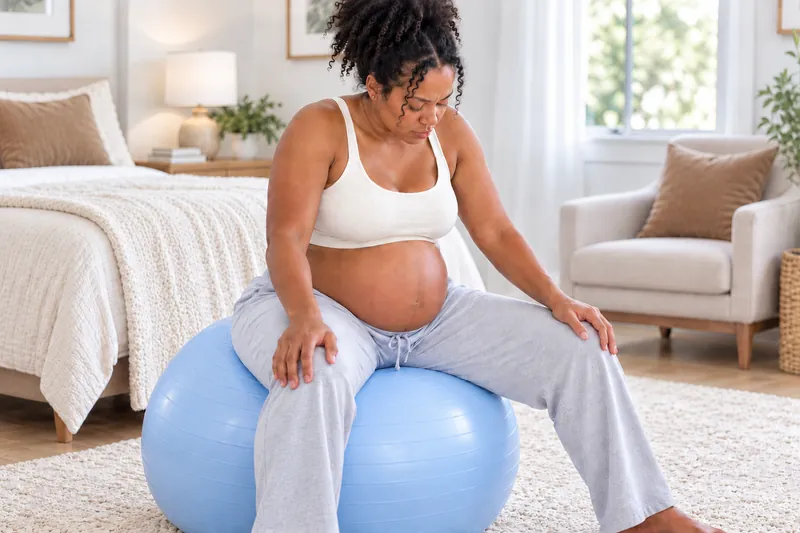
Which birth ball size fits you
The planner uses a published labor-support tip sheet from the Obstetrics Initiative, a Michigan quality program for birthing hospitals. It gives two sizes:
| Your height | Ball size in the tip sheet |
|---|---|
| 5 ft 8 in or less | 65 cm |
| 5 ft 9 in or taller | 75 cm |
The same sheet gives the better test: when you sit on the ball, your hips should be “even with her knees or a little higher.” Height tables are a starting point, balls from different makers sit differently, and inflation changes the height, so check the fit with your feet flat on the floor.
Comfort measures by stage of labor
The plan follows the stages the Comfort Measures class uses, so each idea appears when it is most useful:
- Early labor begins: rest, eat, drink, walk if you like, a warm shower or bath, massage. These come from the American College of Nurse-Midwives handout “Am I in Labor?”.
- Contractions pick up: movement and positions on the birth ball, warm water, warm or cold packs, counterpressure and the hip squeeze.
- Staying grounded: breathing, a visualization or focal point, and letting go of tension between contractions.
- With an epidural, or not sure yet: comfort tools work alongside any birth preference; ask your team which positions fit.
- Time to push: know which pushing positions are possible before you get there.
Tick only what you will actually have. Without a birth ball the ball positions drop out; without a partner the partner cues disappear and the plan still works for you alone.
Positions to try with a birth ball
The tip sheet describes a short sequence: bouncing gently to find a rhythm, circling the hips (or a figure 8), side lunges alternating sides, and resting by sitting on the ball while leaning forward onto the bed or pillows. Someone should steady you the first few times, because sitting on a ball changes your balance late in pregnancy.
What your partner can do
BBU’s article on counterpressure and the hip squeeze explains the two holds partners use most: pressing with the palm directly on the spot that is most uncomfortable, and squeezing both hips at the same time, keeping the pressure steady and firm through the whole contraction, with gentle touch in between. The planner adds a one-line cue like this next to each idea when you tick “a partner or support person.”
When to ask your care team
Everything here is a comfort idea, not a treatment. Ask your provider or nurse which positions fit if you have monitoring, an epidural, a medical condition or any instruction to stay in bed. Stop anything that does not feel right. And if you are unsure whether you are in labor, call your provider; the free contraction timer will give you a clean log to read to them.
Questions people ask
How do I pick a birth ball size?
Start from your height: the tip sheet the planner uses lists 65 cm for 5 ft 8 in or less and 75 cm for 5 ft 9 in or taller. Then sit on it: your hips should be level with your knees or a little higher.
Can I use these positions with an epidural or monitoring?
Ask your care team. The planner lists positions and comfort ideas; your team says which fit your situation.
Do I need a partner?
No. Most ideas work on your own. The partner cues are there for counterpressure, the hip squeeze and holding positions if someone is with you.
Will these measures take the pain away?
The planner makes no promise about pain. It organizes comfort ideas so you can try them, keep what helps and drop what does not.
Sources
- Obstetrics Initiative (Michigan). Moving our Mamas Labor Support Program Tip Sheet (PDF). Posted February 2024. Checked October 9, 2026.
- American College of Nurse-Midwives. Am I in Labor? (Share With Women patient handout), Journal of Midwifery & Women’s Health 48(4). Published 2003. Checked October 9, 2026.
- Birth & Baby University. The Comfort Measures information page (linked above). Checked October 9, 2026.
- Birth & Baby University. Counter Pressure and Hip Squeeze: How To Cope During Labor (article). Checked October 9, 2026.