
By Birth & Baby University · Last updated: October 2026 · 3 min read
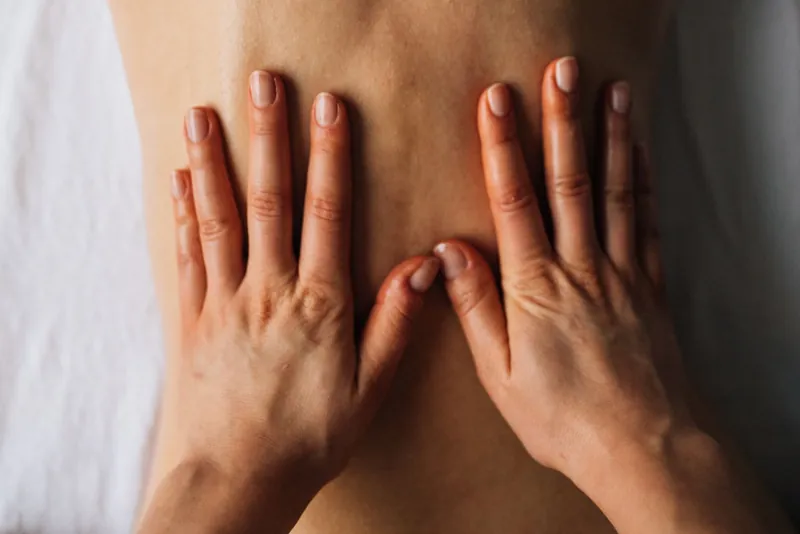
Pressing firmly on the lower back or hips during a contraction is among the most requested things clients ask their doula for. It also illustrates a recurring problem in labor-support research: a technique used daily at the bedside that has rarely been tested by itself. This article states plainly what is and is not known.
Key takeaways
- In the sources reviewed for this article, no randomized trial isolated sustained counterpressure or hip squeeze from massage in general. Evidence comes from related methods such as sacral massage.
- A 2025 meta-analysis of sacral massage found lower pain intensity with moderate-certainty evidence and no clear effect on labor length.
- Cochrane found low-quality evidence that massage reduces pain intensity in first stage, and very low-quality evidence for other outcomes.
- Back pain in labor is not a reliable sign of a posterior baby, so counterpressure should not be framed as a way to correct fetal position.

What the research says
The closest evidence: sacral massage
A 2025 systematic review and meta-analysis of nine studies, eight in the meta-analysis, found labor pain intensity significantly lower with sacral massage (standardized mean difference -2.40, 95% CI -3.5 to -1.29) with very high heterogeneity (I2 97%) but moderate certainty overall for pain. First-stage length (mean difference -0.04, 95% CI -0.27 to 0.20) and total labor length did not differ significantly, and certainty for those outcomes was very low. A single-center randomized trial of 60 women found lower pain scores in latent, active and transition phases and lower anxiety after 30 minutes of sacral massage, with no fetal side effects reported. That trial is small and could not blind participants.
Manual methods more broadly
The Cochrane review of massage, reflexology and other manual methods included 14 trials (10 with data for 1,055 women). It found low-quality evidence that massage lowered first-stage pain intensity compared with usual care (SMD -0.81, 95% CI -1.06 to -0.56), and very low-quality evidence of no clear benefit for labor length, pharmacological pain relief or mode of birth. One trial each suggested less anxiety and a greater sense of control with massage. The authors concluded that massage, warm packs and thermal methods may reduce pain and improve the emotional experience, with quality low to very low and few safety data. The review did not identify trials of counterpressure by that name.
Why it might work, and the limits of the explanation
A 2014 meta-analysis grouped non-drug approaches by proposed mechanism, placing massage, water immersion and positions under gate control, and found that these approaches were associated with fewer epidurals and higher satisfaction. That classification is a framework for thinking about pressure and touch, not proof of how counterpressure works.
Counterpressure and fetal position
A 2010 review of the occiput posterior position concluded that the idea that back pain in labor reliably signals a posterior baby has little scientific support, and that ultrasound is far better than other methods for detecting position. Counterpressure may ease back pain, but the evidence reviewed does not show that it changes position or outcome.

What this means for doulas
- Describe it as a comfort measure. “Many people find firm pressure helps” is honest. “It rotates the baby” is not supported.
- Let the client direct it. Pressure, location and timing differ between people and contractions, and one trial population does not predict an individual.
- Do not infer position from back pain. Concerns about fetal position belong to the clinicians.
- Protect your body and the client’s. Learn safe body mechanics, avoid pressure in areas the client reports as painful, and stop if the client asks.
Putting the evidence into practice
- Teach partners two or three options (heel of the hand on the sacrum, a two-handed hip squeeze, a rolled towel or tennis ball against a wall) and let the client choose.
- Ask for feedback each time: more, less, higher, lower, different.
- Combine with positions or a warm pack when the client wants them, understanding the evidence for warm packs is also very low quality.
- If back pain is severe, unusual or accompanied by other symptoms, tell the nurse or midwife.
The bottom line
Counterpressure is a reasonable, low-risk comfort tool with indirect evidence from massage studies. It should be offered as an option the client controls, not described as a technique that changes labor. The honest message to clients is that many find it helpful and research on this exact technique is thin.
This article is for professional education. It is not medical, legal or tax advice. Check the standards of your certifying organization and the rules where you work.
Sources and further reading
- Makvandi S, et al. Effectiveness of sacral massage during labor in pregnant women: a systematic review and meta-analysis. Midwifery 2025. Read the source
- Akkoz Cevik S, et al. The effect of sacral massage on labor pain and anxiety: a randomized controlled trial. Japan Journal of Nursing Science 2020. Read the source
- Smith CA, et al. Massage, reflexology and other manual methods for pain management in labour. Cochrane Database of Systematic Reviews 2018. Read the source
- Chaillet N, et al. Nonpharmacologic approaches for pain management during labor compared with usual care: a meta-analysis. Birth 2014. Read the source
- Simkin P. The fetal occiput posterior position: state of the science and a new perspective. Birth 2010. Read the source
Hands-on comfort measures are a practical part of birth doula preparation. See the training and mentorship options on the For Doulas page.
More for professionals: the Professionals Blog.


Leave a Reply