

By Birth & Baby University · Last updated: October 2026 · 4 min read
Placing a healthy newborn on a parent’s chest right after birth is one of the most widely endorsed practices in maternity care. The evidence base is large, but not every outcome is equally well established. This article separates the firm findings from the uncertain ones and covers the safety awareness that belongs with the practice.
Key takeaways
- A 2025 Cochrane update of 69 trials found that skin-to-skin contact probably increases exclusive breastfeeding, with moderate-certainty evidence.
- Effects on newborn temperature were statistically significant but not clinically meaningful, while effects on blood glucose and cardiorespiratory stability pointed to benefit with weaker certainty.
- Evidence on maternal outcomes such as bleeding and third stage duration was inconclusive.
- Rare sudden collapse of apparently healthy newborns is most likely in the first hours, so skin-to-skin needs attentive observation.
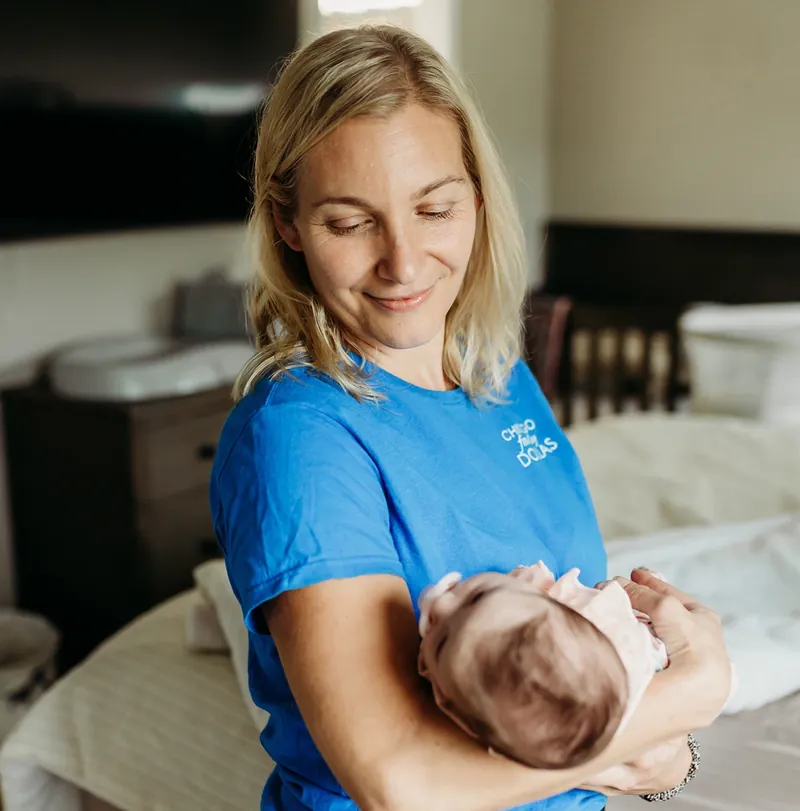
What the research says
Breastfeeding
The 2025 Cochrane review included 69 trials (7,290 mother-infant pairs) of immediate (under 10 minutes) or early (10 minutes to 24 hours) skin-to-skin contact for healthy term and late preterm infants, including some born by cesarean. Compared with standard contact, skin-to-skin probably increased exclusive breastfeeding from discharge to one month (RR 1.36, 95% CI 1.19 to 1.56) and from six weeks to six months (RR 1.38, 95% CI 1.09 to 1.74), both with moderate certainty and substantial heterogeneity. No included trial met all criteria for high-quality methods.
Newborn physiology
The same review found that skin-to-skin probably raised infant temperature by 0.28 degrees Celsius, a difference the authors judged not clinically meaningful, and probably raised blood glucose (mean difference 10.49 mg/dL, based on three small studies with 114 infants). Higher cardiorespiratory stability scores were reported from two small trials (81 infants, low certainty). Maternal blood loss and third stage duration showed little or no difference, with low or very low certainty and high heterogeneity. The review notes that no included studies were conducted in low-income countries.
After cesarean birth
A 2025 meta-analysis of 11 studies with 1,990 participants found that early or immediate skin-to-skin after cesarean shortened time to first attachment by about 52 minutes and raised exclusive breastfeeding at discharge (RR 1.69, 95% CI 1.36 to 2.01), but not at one month or later (RR 1.13, 95% CI 0.73 to 1.54). The authors called for longer follow-up and for clarity on safety in preterm infants and in women with certain health conditions.
Smaller and sicker babies
For babies with low birth weight, a randomized trial in five hospitals across Ghana, India, Malawi, Nigeria and Tanzania (3,211 infants weighing 1.0 to 1.799 kg) found lower 28-day mortality with immediate kangaroo mother care than with conventional care followed by kangaroo care after stabilization (RR 0.75, 95% CI 0.64 to 0.89). The 72-hour difference was not significant, and these findings concern small neonatal unit babies, not routine healthy newborns.
The safety side
A 2016 nursing review of sudden unexpected postnatal collapse describes it as rare but devastating, with up to half of affected newborns dying and many survivors neurologically damaged, and notes that the first two hours coincide with when uninterrupted skin-to-skin and early feeding are encouraged. It emphasizes nursing surveillance and appropriate staffing. This is a narrative review, so it cannot give incidence numbers, but it explains why observation is part of the practice.

What this means for doulas
- Support the practice, describe it accurately. “Associated with more exclusive breastfeeding” is supported. “Guarantees bonding” is not.
- Watch, do not only admire. In those early hours, help the family keep the baby’s face visible, airway clear and position safe, and call the nurse if the baby looks pale, floppy or has trouble breathing. You are an extra set of eyes, not a replacement for clinical monitoring.
- Plan for variation. Cesarean birth, resuscitation, a baby who needs the NICU or a parent who is unwell may change what is possible, and families deserve reassurance that bonding continues when the timing shifts.
- Leave medical thresholds to clinicians. Temperature and glucose management belong to the care team.
Putting the evidence into practice
- Discuss in prenatal visits what the hospital’s routine is, including after cesarean, and how a partner can hold the baby skin-to-skin if the birthing parent cannot.
- Teach families the basics of safe observation: visible face, clear airway, awake support person if the parent is tired.
- Avoid describing skin-to-skin as a cure for later difficulties. The benefits are measured in groups.
- If a family misses the golden hour, tell them later skin-to-skin still has value. The review included early contact up to 24 hours.
The bottom line
Skin-to-skin contact right after birth is supported by a large body of trials, with the clearest benefit for exclusive breastfeeding, and is endorsed by international bodies. The evidence has gaps, and safe observation is part of doing it well. Doulas help by encouraging it, watching alongside the care team and keeping claims proportionate.
This article is for professional education. It is not medical, legal or tax advice. Check the standards of your certifying organization and the rules where you work.
Sources and further reading
- Moore ER, et al. Immediate or early skin-to-skin contact for mothers and their healthy newborn infants. Cochrane Database of Systematic Reviews 2025. Read the source
- Martinez-Hortelano JA, et al. Skin-to-skin contact and breastfeeding after caesarean section: a systematic review and meta-analysis of intervention studies. International Journal of Nursing Studies 2025. Read the source
- WHO Immediate KMC Study Group. Immediate Kangaroo Mother Care and Survival of Infants with Low Birth Weight. New England Journal of Medicine 2021. Read the source
- Ferrarello D, et al. Sudden Unexpected Postnatal Collapse of the Newborn. Nursing for Women’s Health 2016. Read the source
Immediate postpartum and newborn support is a core part of both birth and postpartum doula work. See the training options on the For Doulas page.
More for professionals: the Professionals Blog.



Leave a Reply