
By Birth & Baby University · Last updated: October 2026 · 4 min read
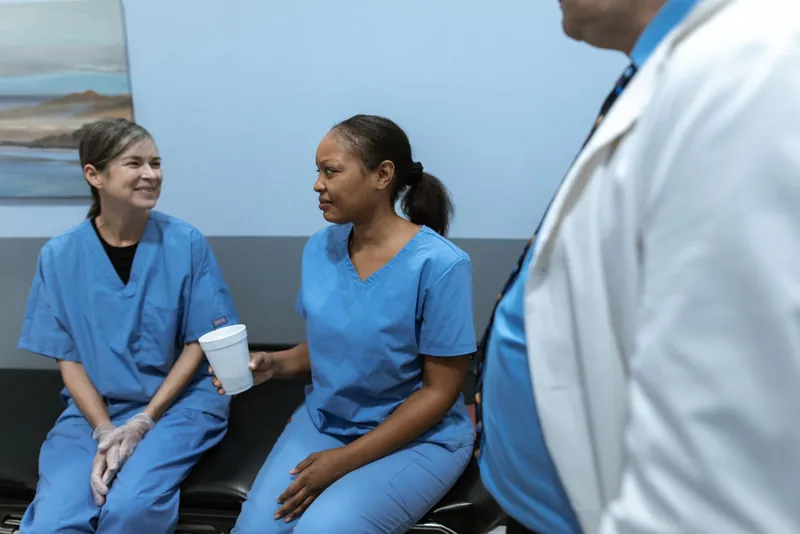
Most hospital births go better when the doula and the care team understand each other early. Research on doula-clinician relationships is mostly qualitative, but it is consistent about what causes friction and what helps. This article pulls together the main findings and turns them into communication habits you can practice, with the caveat that few of them have been tested as interventions.
Key takeaways
- ACOG’s August 2026 Committee Statement 31 says that when a doula speaks on a patient’s behalf, it may affect the clinician’s sense of their relationship with the patient, and it recommends clinicians acknowledge the doula, verify with the patient and encourage direct communication with the patient.
- In interviews with 47 hospital maternity practitioners, positive experiences centered on doulas’ supportive role, while conflict was linked to unclear roles and limited familiarity with doulas.
- Structured team huddles that include the patient were associated with higher patient-reported shared decision making in a four-hospital study, which suggests clear communication structures help everyone.
- Communication works best when the doula amplifies the client’s own voice and does not speak instead of the client.

What the research says
What clinicians and doulas say about friction
A multi-hospital interview study of 47 maternity practitioners (obstetricians, family physicians, nurses and nurse-midwives) found varied views of doulas. Positive experiences centered on doulas’ supportive role and strong relationships with patients, while some practitioners reported frustration, anger and resentment. The authors linked some conflict to a cross-cultural divide between obstetric culture and a natural birth counterculture, and suggestions for improvement centered on mutual respect, education about doulas’ training and clarification of roles. A Delaware qualitative study with 11 doulas and 12 licensed providers found agreement on key elements of training, the value of certification and the importance of relationship-building across the care team. A 2025 interview study of seven doulas, five of whom identified as Black or African American, described barriers to inclusion in team-based care and facilitators to collaboration, and emphasized mentorship for novices moving into hospital settings. All three studies are small and regional.
What ACOG recommends for the clinician side
ACOG’s Committee Statement 31, Partnering With Doulas in Clinical Settings notes that medical education rarely includes collaboration with doulas, and that when the doula communicates for the patient it may exacerbate power dynamics. Its suggested strategies include asking patients at prenatal visits whether they are working with a doula, welcoming doulas to appointments, and, when a doula speaks for the patient, acknowledging the doula, asking the patient to verify, encouraging direct communication with the patient and, if the clinician thinks it helpful, inviting another team member to join. It also encourages a postbirth debrief that includes the doula if communication became adversarial in an emergency, and recommends channels for doulas to raise concerns. These are recommendations to clinicians, not measured interventions.
Structure helps
The TeamBirth quality improvement program uses huddles that include the patient and the full care team to review preferences, plans and when the next huddle will happen. In a prospective observational study of 1,253 patients at four U.S. hospitals, having at least one huddle was associated with a 3.13-point higher score on a shared decision-making scale. It was not a randomized trial and did not study doulas specifically.
What this means for doulas
- Introduce yourself and your role in one sentence. Say who you are, who you support, and that you are non-medical.
- Speak through the client when you can. Help the client frame questions, then step back so the team hears from them.
- Ask, do not tell. “Can you tell us what you are seeing?” invites explanation and avoids sounding like a challenge.
- Keep conflict private. If you disagree with a clinician, raise it with the client, away from the bed, and let them decide how to proceed.
- Know local rules. Spaces such as operating rooms and triage may have their own policies.
Putting the evidence into practice
- Practice a short introduction with each team member: name, role, who you are supporting, “I do not give medical advice.”
- Teach clients three questions before labor: “What is the concern?”, “What are the options?” and “What happens if we wait?” Check with your mentor that these suit your certifier’s guidance.
- If the client asks you to speak, say it plainly and give the floor back: “She would like to ask…”
- Thank staff by name, and note what worked for your debrief.
- After a tense birth, write down what happened for your reflection, and use any hospital channel for doula feedback only with the client’s consent and no identifying details.
The bottom line
Good hospital communication for a doula means being clear about your role, helping the client speak for themselves and treating clinicians as partners. The research describes what causes friction and what clinicians say they want, but few specific techniques have been tested, so treat your habits as practice you review rather than proven methods.
Related reading: How Doulas Can Build Productive Relationships With Obstetricians and Midwives; The Difference Between Advocacy and Clinical Decision-Making in Doula Care; How to Communicate Effectively During High-Stress Birth Situations.
This article is for professional education. It is not medical, legal, financial or tax advice. Check the standards of your certifying organization and the rules where you work.
Sources and further reading
- American College of Obstetricians and Gynecologists. Committee Statement No. 31: Partnering With Doulas in Clinical Settings. Obstetrics & Gynecology 148(2), August 2026. Read the source
- Neel K, et al. Hospital-based maternity care practitioners’ perceptions of doulas. Birth 2019. Read the source
- Knight EK, et al. “We Are All There to Make Sure the Baby Comes Out Healthy”: a qualitative study of doulas’ and licensed providers’ views on doula care. Delaware Journal of Public Health 2024. Read the source
- Burke LT, et al. Racial Minority Doulas’ Perceptions of Hospital Team-Based Care. MCN: The American Journal of Maternal Child Nursing 2025. Read the source
- Neergheen VL, et al. Assessing patient autonomy in the context of TeamBirth. Birth 2024. Read the source
Birth & Baby University’s birth doula training and mentorship, outlined on the For Doulas page, include working alongside hospital teams. Before you choose a program, ask how it teaches communication with clinicians and what it says about scope.
More for professionals: the Professionals Blog.



Leave a Reply