
By Birth & Baby University · Last updated: October 2026 · 3 min read
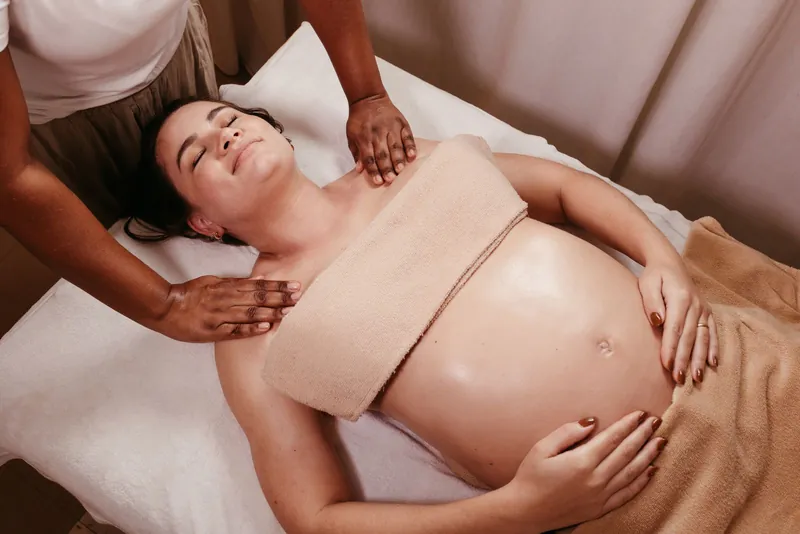
Touch is central to labor support, and clients often assume massage “works.” The research is encouraging in direction but weak in quality, and the effects are modest. This article reviews massage and a touch-based technique called therapeutic touch, and explains how to talk about both.
Key takeaways
- Cochrane found low-quality evidence that massage reduces first-stage pain intensity, with very low-quality evidence for no clear effect on labor length or mode of birth.
- Single trials suggested less anxiety and more sense of control with massage, which matters for experience even when pain scores shift modestly.
- A 2026 single-center trial found therapeutic touch reduced pain scores by about 7 to 10 percent versus routine care, with no clear advantage over distraction.
- Few trials reported safety outcomes, so “no harm found” is not the same as “safe for everyone.”

What the research says
Massage and other manual methods
The 2018 Cochrane review included 14 trials, 10 of which (1,055 women) contributed to meta-analysis. Most had high risk of performance and detection bias, and no trials of reflexology were found. For massage, there was low-quality evidence of lower first-stage pain intensity than usual care (SMD -0.81, 95% CI -1.06 to -0.56; six trials, 362 women). Findings for length of labor, pharmacological pain relief, assisted birth and cesarean were very low quality with no clear benefit. One trial reported less anxiety, one reported a greater sense of control, and two reported higher satisfaction, all with low or very low quality evidence. Warm packs showed reduced pain and shorter labor in very low-quality evidence, and the authors concluded that massage, warm packs and thermal methods may have a role in reducing pain and improving emotional experience, with few trials reporting safety outcomes.
Therapeutic touch
A 2026 single-center randomized trial in Iran assigned 93 first-time mothers to distraction, therapeutic touch or routine care after educational sessions before birth. Therapeutic touch lowered pain versus routine care on the visual analog scale at hours 3 and 4 (mean difference -1.24 and -1.76) and on a faces scale at hour 4, representing reductions of roughly 7 to 10 percent. Distraction showed no significant reduction, and the difference between therapeutic touch and distraction was not significant. The trial was small, relied on convenience sampling and had baseline differences in occupation and education between groups. Participants cannot be blinded to this kind of intervention, and pain ratings are subjective.
Mind-body context
A 2024 meta-analysis of 24 trials included therapeutic touch as one of six categories of mind-body interventions and reported that all categories were associated with shorter labor compared with control conditions. Because pooled results had very high heterogeneity and the review judged overall confirmation as still needed, its authors recommended more rigorous trials. Specific effects of therapeutic touch cannot be separated from the abstract alone.
Placing touch among options
The Cochrane overview of labor pain management reviews placed massage in the “may work” category, with evidence mainly limited to single trials and few adverse effects, alongside immersion, relaxation and acupuncture.
What this means for doulas
- Offer touch as comfort and connection. Even when pain scores move modestly, trials point to potential gains in anxiety and sense of control.
- Ask first, every time. Preferences about touch change during labor and may be affected by history, culture or trauma. Consent is ongoing.
- Do not promise labor speed or fewer interventions. The Cochrane evidence for those outcomes is very low quality.
- Stay within scope. Light massage and comfort touch are standard. Deep tissue work, manipulation or chiropractic-style techniques are typically outside doula scope, and the care team should be consulted if a client has pain that seems unusual.
Putting the evidence into practice
- Teach partners one or two simple massage patterns in prenatal visits and invite the client to choose.
- Use warmth where the facility and client agree, noting that the evidence for warm packs is very low quality.
- Check in about pressure, speed and location, and respect a “no” immediately.
- If the client has a skin condition, injury, clotting concern or any medical issue, ask the care team before using firm touch.
The bottom line
Massage and touch-based comfort measures are low-risk and may help with pain and emotional experience, but the supporting trials are small and of low quality. Describe benefits modestly, keep consent central and leave clinical judgments to the care team.
This article is for professional education. It is not medical, legal or tax advice. Check the standards of your certifying organization and the rules where you work.
Sources and further reading
- Smith CA, et al. Massage, reflexology and other manual methods for pain management in labour. Cochrane Database of Systematic Reviews 2018. Read the source
- Bakhtiari Z, et al. Therapeutic Touch vs Distraction for Labor Pain: A Randomized Controlled Trial. Pain Management Nursing 2026. Read the source
- Wang R, et al. Effectiveness of mind-body interventions in labour pain management during normal delivery: a systematic review and meta-analysis. International Journal of Nursing Studies 2024. Read the source
- Jones L, et al. Pain management for women in labour: an overview of systematic reviews. Cochrane Database of Systematic Reviews 2012. Read the source
Comfort touch is a core hands-on skill in doula work. See the training and mentorship options on the For Doulas page.
More for professionals: the Professionals Blog.



Leave a Reply