
Free tool · For birth doulas and trainees
Labor Support Plan Builder
The birth plan is the client’s. This is yours: the intake questions to settle, the comfort measures you will offer in each phase and what you will actually do, how you will work with the birth team, and the follow-up visits, all on one printable page.
- Free
- No signup or email
- Works right on this page
- Nothing you enter is sent anywhere; saving is your choice
What goes in a support plan
A support plan has four parts. Intake: the practical and preference questions you settle before labor, such as how to reach the family, who will be at the birth, when they will call you, the provider’s instructions on when to call or come in, what helps them feel calm, and any family, cultural or religious considerations. Labor support: what you will offer in early labor, active labor and pushing. Communication with the birth team. Follow-up. Intake here is administrative and preference-based; it is not health screening.
Comfort measures and positions
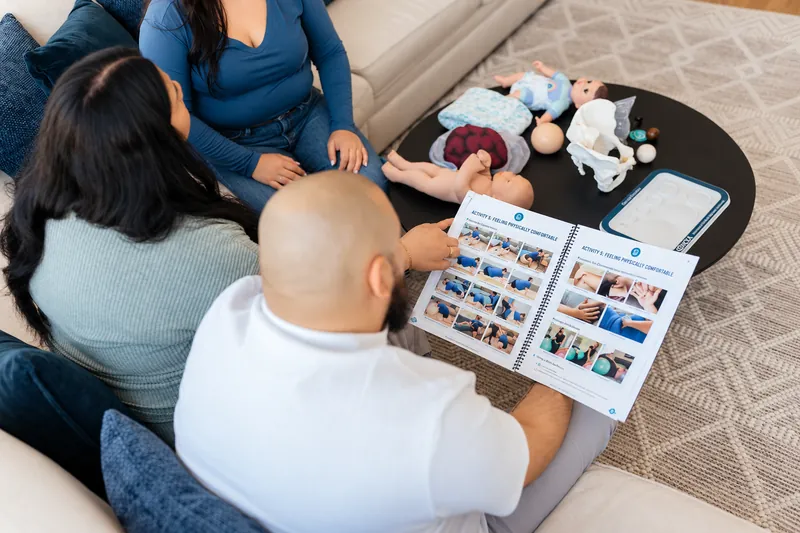
Tick the measures you will offer and the plan sorts them into phases with the doula’s own action for each: walking, rest, food and water, and a warm shower early on; the birth ball sequence, counterpressure, the hip squeeze, breathing, warm and cold packs and light touch in active labor; and pushing positions the client wanted to try, with the care team deciding which are possible. The comfort content is the same public set the family tools use (the ACNM labor handout, the Obstetrics Initiative tip sheet and BBU’s counterpressure article), written here as what you do.
Context changes the plan: an epidural adds position help in bed, an induction prepares for a long early phase, a VBAC reminds you to support the questions the client agreed with their provider, and a previous difficult birth adds a conversation about what would help them feel safe.
Communicating with the birth team
The plan prints four principles: introduce yourself as the client’s doula; the client speaks and decides, and you help them ask the questions they want answered; you do not give medical advice or perform clinical tasks; and you share preferences respectfully and step back when the team needs space.
Planning follow-up
Choose up to four postpartum visits. The plan gives each a window after the birth and, if you add the due date, the dates those windows would fall on if the baby arrives on time. The windows are planning defaults to agree with the family. BBU’s Labor Doula Training Workbook goes further on every part of this.
Questions people ask
How is this different from a birth plan?
The birth plan is the client’s preferences; this is the doula’s plan for supporting them.
Does it replace the training?
No. It is a working template; the training teaches the practice.
Can I print it?
Yes, as one page with space to write the intake answers.
Sources
- American College of Nurse-Midwives. Am I in Labor? (Share With Women patient handout), Journal of Midwifery & Women’s Health 48(4). Published 2003. Checked October 9, 2026.
- Obstetrics Initiative (Michigan). Moving our Mamas Labor Support Program Tip Sheet (PDF). Posted February 2024. Checked October 9, 2026.
- Birth & Baby University. The Labor Doula Training Workbook information page (linked above). Checked October 9, 2026.
- Birth & Baby University. Labor Doula Training Workbook product description. Checked October 9, 2026.
- Birth & Baby University. Counter Pressure and Hip Squeeze (article). Checked October 9, 2026.