
By Birth & Baby University · Last updated: October 2026 · 8 min read
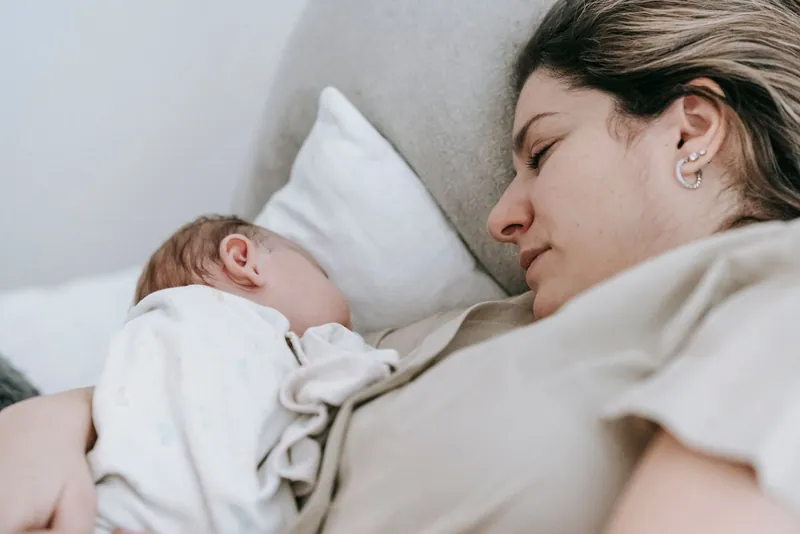
Many newborns nap best when they are being held, and many parents spend those naps on the couch, in a chair or in a carrier, wondering whether they are creating a “bad habit” or a danger. “Contact napping” is a parenting-community term, not a research category, which makes it hard to evaluate directly. What can be assembled from the literature is the evidence on carrying and holding, the evidence on the sleep surfaces and devices that tired adults and babies end up on, and the guidance on skin-to-skin contact in the first hours and days. This article sets those pieces side by side, describes where the research is thin, and explains how a postpartum doula can talk with families about holding a sleeping baby without either dismissing the practice or understating the risk.
Key takeaways
Quick answer: holding or carrying a baby is supported by trial evidence as a way to reduce crying, and skin-to-skin contact is supported for breastfeeding and early transition. The risk comes from falling asleep, with or without a baby, on surfaces or in positions that are unsafe: sofas, armchairs, car seats and similar sitting devices, and unsupervised skin-to-skin in the first hours after birth. The AAP’s rule is simple: if an adult may fall asleep, put the baby on their back in a safe sleep space first.
- A randomized trial of 99 mother-infant pairs found that supplemental carrying reduced crying and fussing by 43% at 6 weeks, with increased feeding frequency and no change in sleep.
- The AAP advises moving a baby who falls asleep in a car seat, stroller, swing, infant carrier or sling to a firm sleep surface on their back as soon as possible, and says the risk of sleep-related infant death is up to 67 times higher when an infant sleeps with someone on a couch, soft armchair or cushion.
- A US analysis found 3.0% of sleep-related infant deaths (348 of 11,779) occurred in sitting devices, and in those deaths in car seats the seat was used as directed in fewer than 10% of cases.
- A Swedish cohort study of sudden unexpected postnatal collapse found it was associated with early unsupervised skin-to-skin care and bed sharing, and half of the cases occurred in the first four hours after birth.
What the research says
Benefits of holding and carrying. Hunziker and Barr’s 1986 randomized trial assigned 99 mother-infant pairs to supplemental carrying (more carrying throughout the day beyond that during feeding and crying) or to a control group. At the age of peak crying, 6 weeks, infants who received supplemental carrying cried and fussed 43% less overall (1.23 versus 2.16 hours a day) and 51% less during the evening hours, with similar but smaller decreases at 4, 8 and 12 weeks. Decreased crying was associated with increased contentment and feeding frequency but no change in feeding duration or sleep. This is the best trial evidence found on carrying, but it is a single, older study of awake carrying, not of sleeping on a caregiver, and it does not show that held naps are longer or safer. The Cochrane review of early skin-to-skin contact by Moore and colleagues (2016) found that mothers who had early skin-to-skin contact with healthy newborns were more likely to be breastfeeding at one to four months (average risk ratio 1.24, 95% confidence interval 1.07 to 1.43; moderate-quality evidence), but no trial met all quality criteria and its authors called for larger studies. Those trials studied contact in the first hours and days, with observation, not extended sleeping.
Where the danger sits. The AAP’s safe sleep guidance for parents (updated September 2026) does not use the term contact napping. It says a newborn should be placed skin-to-skin with the parent as soon as possible after birth for at least an hour, after which, or when the mother needs to sleep, the baby should go on their back in a bassinet with no incline. It says that if a baby falls asleep in a car seat, stroller, swing, infant carrier or sling, parents should move the baby to a firm sleep surface on their back as soon as possible, and that the risk of sleep-related death is up to 67 times higher when infants sleep with someone on a couch, soft armchair or cushion, so parents should avoid falling asleep with their baby in other spots as well as the bed. Liaw and colleagues’ analysis of infant deaths in sitting devices (2019) reviewed 2004 to 2014 US fatality review data. Of 11,779 sleep-related infant deaths, 348 (3.0%) occurred in sitting devices, 62.9% of those in car safety seats, and in the car-seat cases the seat was used as directed in fewer than 10%. At least one risk factor was present in 81.9% of sitting-device deaths. The odds of such a death were higher when a child care provider or baby-sitter was supervising. The authors concluded that using car seats for sleep outside travel may pose a risk. This is a descriptive analysis of deaths, so it cannot give the risk of any single nap.
The newborn period. Forsberg and colleagues’ 2026 retrospective Swedish cohort study screened records of 483,284 infants born in Stockholm from 2002 to 2022. It identified 149 cases of sudden unexpected postnatal collapse in the first week among near-term infants with good adaptation, an incidence of 31 per 100,000 live births, with half occurring in the first four hours, mortality of 7% and neurological sequelae in 26%. The authors report that these collapses were associated with early unsupervised skin-to-skin care and bed sharing and that guidelines promoting safe sleep and skin-to-skin care should be implemented. The finding does not argue against skin-to-skin contact, which the AAP recommends, but it highlights the need for observation of a newborn in the first hours.
What this means for doulas
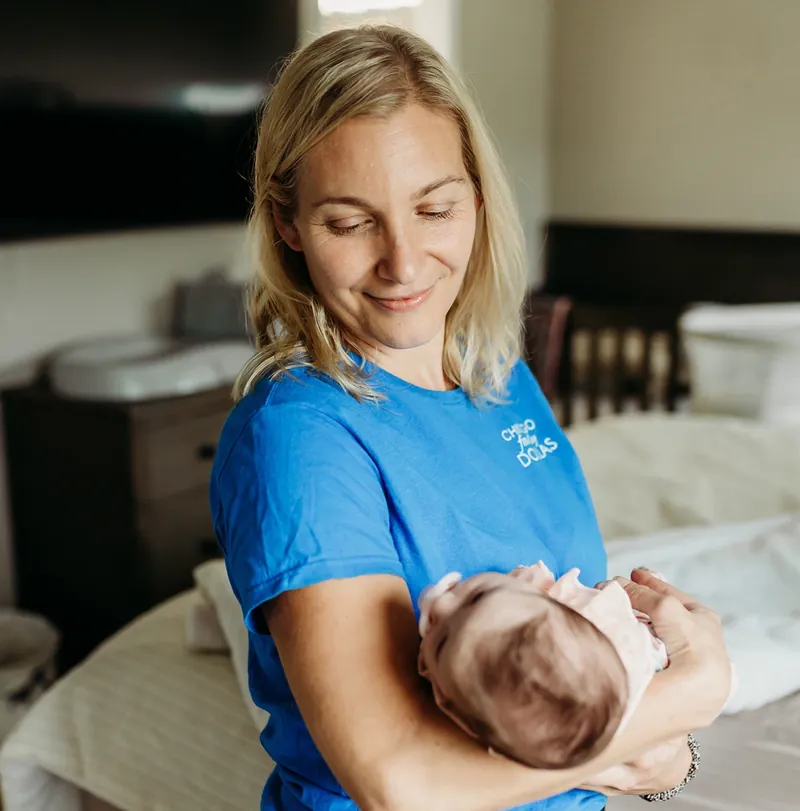
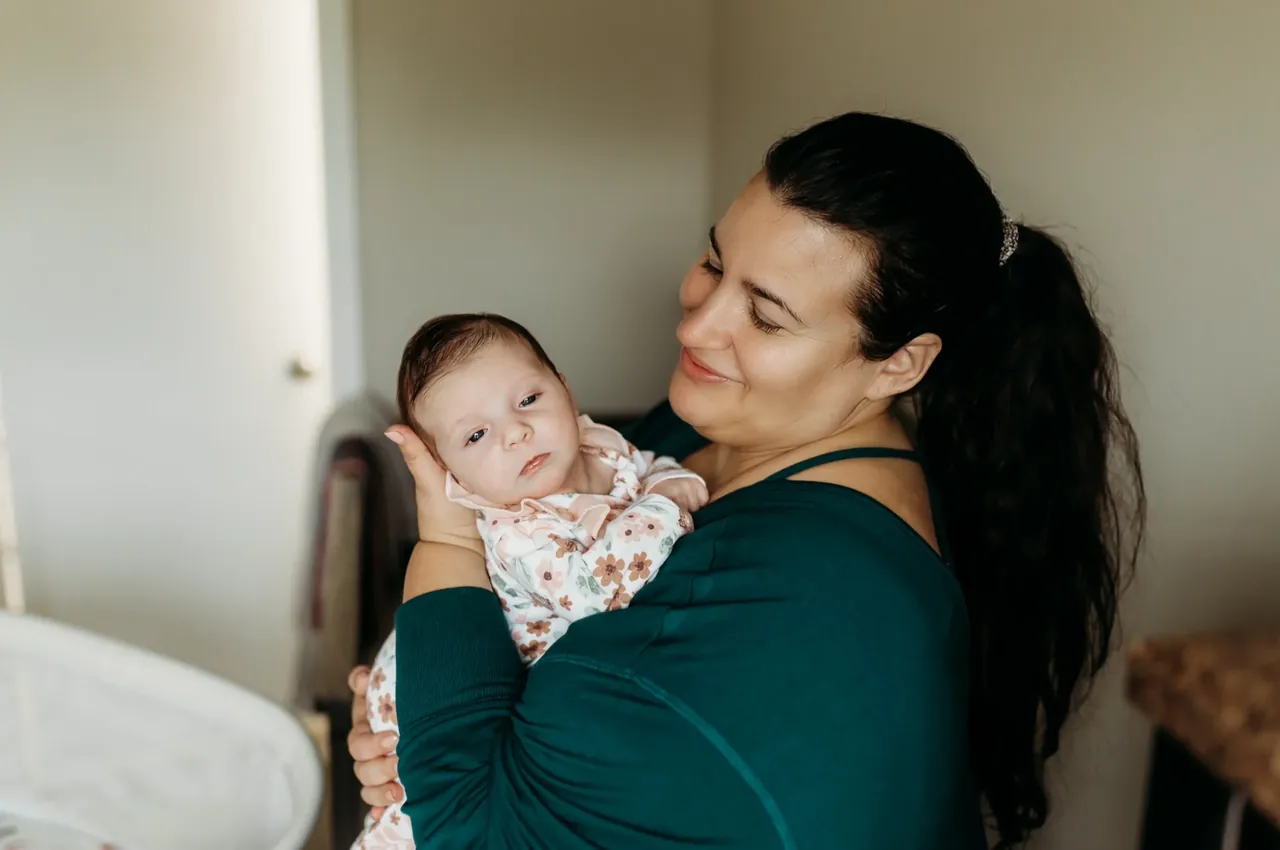
- Do not shame holding. Holding and carrying are normal, supported by trial evidence for crying, and help many babies settle. The danger is sleep on unsafe surfaces or an unwatched baby.
- Teach the handoff rule. If the adult is awake and alert, holding a sleeping baby is a different situation from the adult dozing off. The AAP says to move the baby to a safe sleep space before sleeping. Put it into a plan: who is awake, which phone alarm, where the bassinet is.
- Name the surfaces to avoid. Sofas, armchairs and cushions; car seats, swings and other sitting devices for sleep outside travel; and any position where the baby’s chin can fall to the chest.
- Be careful with carrier advice. No research could be reviewed on the safety of specific baby carriers for sleeping babies. The AAP says to move a baby asleep in a carrier or sling to a firm surface, so do not teach carrier sleep as a safe nap.
- Watch the newborn hours. The Swedish study links collapse with early unsupervised skin-to-skin care, so in the first hours after birth make sure someone awake is watching the baby’s color, breathing and position, and follow the hospital or birth center’s own policy, which varies.
Putting the evidence into practice
- Ask where naps happen. Couch, bed, chair, carrier, car seat. Learn the real pattern before advising.
- Offer alternatives that fit. A bassinet in the room that is easy to reach, a chair used only while awake, or taking turns so one adult holds while the other is awake and rested.
- Use a wake-up plan. If a parent is falling asleep while holding the baby, suggest a transfer routine or a call to the other adult.
- Offer upright daytime holding while awake to support crying and settling, consistent with the carrying trial, and talk about gentle ways to transition the baby to a safe space.
- Link to safe sleep and parental rest. See Safe Sleep Recommendations: What Every Postpartum Doula Must Know and Supporting Exhausted Parents While Maintaining Evidence-Based Safe Sleep Practices.
Limits and uncertainty
No studies of contact napping itself were found, so benefits for sleep length, development or bonding from held naps are untested. The carrying trial is from 1986 and concerns awake carrying and crying. The sitting-device paper analyzes deaths from 2004 to 2014 and cannot estimate risk per nap. The Swedish cohort is retrospective and describes a rare event in newborns. The AAP guidance is from a general-audience page that summarizes its policy statement. This article draws on abstracts of the research papers. Practices differ across cultures, and some communities carry babies routinely as part of traditional care, so guidance should be delivered respectfully and with attention to the AAP’s specific cautions about sleep.
The bottom line
Holding a baby is good for crying and comfort, and skin-to-skin contact helps breastfeeding, but sleeping adults and babies together on sofas, chairs and sitting devices is a serious hazard. The AAP’s clear rule is to move the baby to a firm, flat sleep space on their back before an adult may sleep. A doula’s job is to support closeness while keeping sleep safe: plan for the tired moments, keep the newborn hours observed and refer questions about individual risk to the pediatric provider.
Birth & Baby University’s For Doulas page brings together its postpartum doula training, recertification and mentorship for doulas who support families with newborn sleep and settling. Confirm that any program meets your certifier’s, employer’s or state’s requirements before you enroll.
This article is for professional education. It is not medical, legal or tax advice. Check the standards of your certifying organization and the rules where you work. For concerns about a baby’s health, contact a pediatric provider or emergency services.
Sources and further reading
- Hunziker UA, Barr RG. Increased carrying reduces infant crying: a randomized controlled trial. Pediatrics (1986). Read the source
- Moore ER, et al. Early skin-to-skin contact for mothers and their healthy newborn infants. Cochrane Database of Systematic Reviews (2016). Read the source
- American Academy of Pediatrics. How to Keep Your Sleeping Baby Safe: AAP Policy Explained (HealthyChildren.org, updated September 2026). Read the source
- Liaw P, et al. Infant deaths in sitting devices. Pediatrics (2019). Read the source
- Forsberg D, et al. Sudden unexpected postnatal collapse: a retrospective cohort study describing incidence, risk factors and role of perinatal transition. Acta Paediatrica (2026). Read the source
More for professionals: the Professionals Blog.


Leave a Reply