
By Birth & Baby University · Last updated: October 2026 · 8 min read
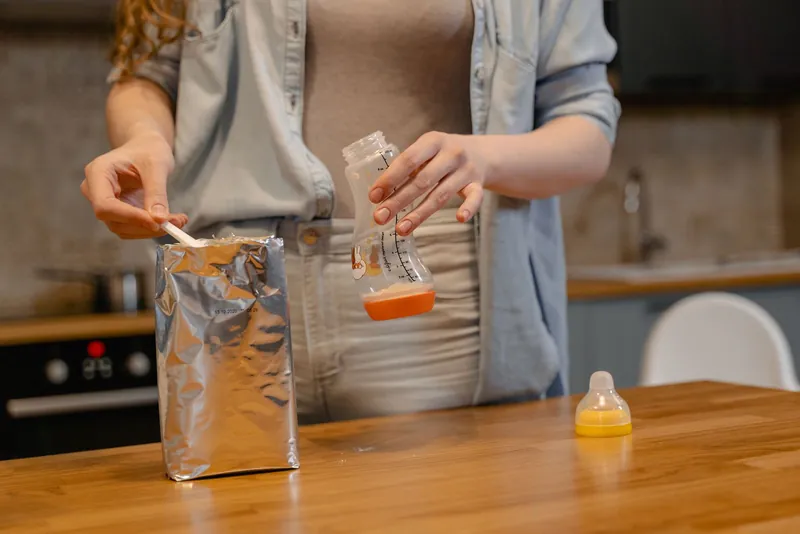
Many families use infant formula, some from the first day, others alongside breastfeeding or after breastfeeding ends. A postpartum doula is often the person in the kitchen when a parent asks whether the water needs boiling, how long a bottle can sit out or why the baby spits up when feeds go quickly. Preparation guidance is concrete and well documented, and some of it has changed or differs between sources. Responsive feeding, in which caregivers use the baby’s cues to set the pace and volume, is widely recommended, though the evidence behind its bottle-feeding techniques is still early. This article reviews both areas and notes where agencies’ wording differs.
Key takeaways
Quick answer: follow the manufacturer’s directions exactly, wash hands, measure the water first and then add the powder, never dilute or concentrate formula, and use or refrigerate prepared bottles on a strict clock. Babies under 2 months, those born prematurely and those with weakened immune systems need extra care when powdered formula is used. Responsive feeding means watching for hunger and fullness cues instead of pushing the baby to finish a bottle.
- The CDC (page reviewed May 2026) says most babies can be fed powdered formula mixed with tap water as the container directs, while for babies under 2 months, born prematurely or with a weakened immune system it advises boiling water and waiting about 5 minutes before mixing. The FDA handout says this uses very hot water (at least 158 degrees Fahrenheit, 70 degrees Celsius) to protect against Cronobacter.
- Both the CDC and FDA say to use prepared formula within 2 hours of preparing it and within 1 hour from the start of feeding, to throw away leftovers and to refrigerate formula that will not be used right away and use it within 24 hours.
- The AAP warns that diluting formula, or giving water or juice in the first 6 months, can cause water intoxication, slow growth and seizures.
- A small experiment with 29 mother-infant pairs found paced bottle-feeding slowed feeding rates and lengthened meals compared with typical bottle-feeding, with no significant difference in milk intake. The authors describe the evidence as preliminary.

What the research says
Preparation basics. The AAP’s How to Safely Prepare Baby Formula With Water (last updated February 2026) says to follow directions closely whatever the form of formula, and never to add water to ready-to-feed formula. It says that unless there is known contamination, tap water may be used for concentrate or powder, that babies in the first 6 months do not need water or juice in addition to formula or breast milk unless a pediatrician advises it, and that dilution reduces nutrients, upsets electrolytes and can lead to major problems including seizures. Its key points: add powder to water, not the other way around; use boiled water for babies under 2 months, those born prematurely and those with weakened immune systems, letting it cool for about 5 minutes; cool a prepared bottle to body temperature if feeding right away; and test a few drops on the inside of the wrist. It also says a bottle for a healthy baby can be made from powder and room-temperature tap water just before feeding. It tells parents to discard prepared formula within 1 hour after feeding the baby from the bottle, to refrigerate unfed prepared formula for up to 24 hours, and to cover, refrigerate and discard after 48 hours an open container of ready-to-feed or concentrated formula.
The CDC’s infant formula preparation and storage page (reviewed May 2026) is consistent. It advises washing hands first, measuring the water before adding the powder, and for high-risk infants boiling the water and waiting about 5 minutes before mixing, noting that very hot water (around 158 degrees Fahrenheit, 70 degrees Celsius) is needed to eliminate bacteria such as Cronobacter. It says to use prepared formula within 2 hours of preparation and within 1 hour from when feeding begins, to refrigerate it immediately if it will not be used within that time and use it within 24 hours, and to throw out what is left in the bottle after feeding. It also says an opened container of powder should be stored in a cool, dry place and used within 1 month, per label instructions. The FDA’s handout on preventing Cronobacter illness gives the same pattern for babies under 2 months, born prematurely or with weakened immune systems: boil water, let it cool about 5 minutes, add the exact amount of formula, shake instead of stirring, cool the capped bottle under running water or in an ice bath without letting water into the bottle, test on the wrist, and use within the same time limits. The sources use slightly different wording for the clock: the AAP says discard within 1 hour after feeding, and the CDC and FDA say within 1 hour from the start of feeding, so teach the shorter, stricter version.
Responsive and paced feeding. The AAP’s page on how often and how much to feed (last updated April 2024) recommends responsive feeding: look for hunger cues before crying, which is a late sign, and remember babies also suck for comfort. It says bottle-fed newborns usually eat every 2 to 3 hours and that 8 feeds in 24 hours is generally recommended as the minimum, with 1 to 2 ounces per feed after the first day or two. It warns that bottle-fed infants may be more likely to be overfed because bottles flow faster and may not prompt a baby to pull away, that overfed babies can have stomach pain, gas and spit-up, and that pausing during transitions can help a baby notice fullness. Paced bottle-feeding is a technique intended to bring those benefits. In a within-subject experiment, Ventura, Drewelow and Richardson (2025) observed 29 mothers feeding their term infants by breast, with typical bottle-feeding and with paced bottle-feeding. Paced feeding led to significantly longer feeds and slower feeding rates than typical bottle-feeding, with no significant difference in milk intake. Maternal sensitivity to cues did not differ overall between the two bottle methods and was highest during breastfeeding, though paced feeding was associated with greater sensitivity when infants gave less clear cues. The authors call the findings preliminary evidence.
What this means for doulas
- Teach the sequence, not just the rules. Hands, clean equipment, water first, powder second, mix, cool, test, feed, discard. A printed card on the counter helps in a tired household.
- Match the advice to the baby. The extra boiling step applies to babies under 2 months, those born prematurely and those with weakened immune systems. The AAP says other babies can be fed with room-temperature tap water. If you are unsure about a baby’s status, ask the pediatric provider rather than guessing.
- Do not change the recipe. No extra water, no stretching powder to save cost, no homemade formula. The AAP gives financial help routes: the pediatrician, local health department, food pantry or social service agency.
- Use cues, not clocks, for volume. The AAP lists ranges but says to feed when the baby shows hunger. Watching for fullness signs (turning away, relaxed hands) is covered in How Newborns Communicate: Understanding Early Hunger, Stress, and Engagement Cues.
- Offer paced feeding as an option. Present it as promising and low-risk, not as proven.
- Stay in scope. Formula choice for allergy, reflux or medical conditions, and any concerns about growth or vomiting belong with the pediatric provider.
Putting the evidence into practice
- Ask what the family uses. Which formula, what form, what water, and how it is prepared today. Offer improvements without criticism.
- Set up the station. Clean surfaces, a place for washed bottles and a way to time bottles (a phone timer or a sticky note with the prep time).
- Demonstrate a paced feed. Hold the baby more upright, keep the bottle roughly horizontal so milk flows slowly, pause and let the baby swallow and breathe, and stop when the baby signals fullness.
- Combine feeding methods respectfully. For families who give both breast milk and formula, see Combination Feeding: Supporting Families Without Judgment or Misinformation.
- Refer on warning signs. Fever in a young baby, repeated vomiting, poor weight gain, signs of dehydration or any concern after a formula recall or product change should go to the pediatric provider. See Recognizing Early Signs of Dehydration in Newborns.
Limits and uncertainty
The preparation guidance comes from agencies and is consistent in outline, but the wording of time limits and the groups for whom extra steps apply differs slightly between pages, and the CDC formula page cited here shows a review date of May 14, 2026. This article does not review studies testing whether boiling and cooling for about 5 minutes reliably reaches the 158 degrees Fahrenheit target in a home setting, or recall and shortage guidance. The paced-feeding experiment was small, short and in one group of term infants, so it shows effects on feeding pace but not on long-term weight or health. This article draws on the AAP and CDC pages, the FDA handout and the abstract of the experiment. This article does not address special or hypoallergenic formulas, preparing formula during water emergencies or international guidance.
The bottom line
Safe formula feeding rests on a short list of habits: clean hands and equipment, exact measures, water first, correct water for higher-risk babies, strict time limits and discarding leftovers. Responsive feeding adds attention to the baby’s cues and may be helped by pacing, though that evidence is early. A doula supports families best by teaching the routine without judgment, adapting it to the baby’s age and health, and sending medical questions to the pediatric provider.
Birth & Baby University’s For Doulas page sets out its postpartum doula training, recertification and mentorship for professionals who support families in the early weeks. Confirm that any program meets your certifier’s, employer’s or state’s requirements before you enroll.
This article is for professional education. It is not medical, legal or tax advice. Check the standards of your certifying organization and the rules where you work. For concerns about a baby’s health, contact a pediatric provider or emergency services.
Sources and further reading
- Centers for Disease Control and Prevention. Infant formula preparation and storage (page reviewed May 2026). Read the source
- U.S. Food and Drug Administration. Help prevent Cronobacter illness: prepare and store powdered infant formula safely. Read the source (read October 2026)
- American Academy of Pediatrics. How to Safely Prepare Baby Formula With Water (HealthyChildren.org, last updated February 2026). Read the source
- American Academy of Pediatrics. How Often and How Much Should Your Baby Eat? (HealthyChildren.org, last updated April 2024). Read the source
- Ventura AK, Drewelow VM, Richardson TN. Does paced bottle-feeding improve the quality and outcome of bottle-feeding interactions? Early Human Development (2025). Read the source
More for professionals: the Professionals Blog.



Leave a Reply