

By Birth & Baby University · Last updated: October 2026 · 7 min read
Recommendations about the “golden hour” are widely repeated, and they are sometimes repeated with more certainty than the evidence supports. Postpartum doulas usually arrive after the first hour has passed, yet they meet families whose first feed went smoothly, was delayed, or happened under conditions nobody planned. Understanding what the major organizations recommend, what the research shows and where it is thin lets a doula support families without either inflating the first hour or leaving a parent feeling that a missed window has doomed their feeding plans.
Key takeaways
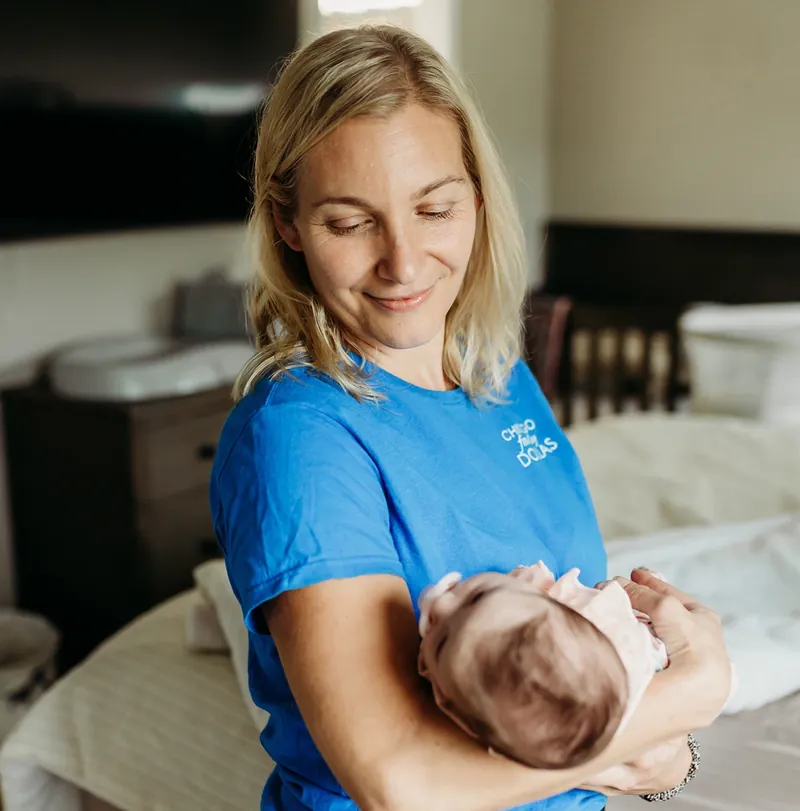
Quick answer: WHO and UNICEF recommend that all infants begin breastfeeding within 1 hour of birth, and the AAP encourages nursing within the first hour in skin-to-skin contact. Evidence supports skin-to-skin contact for breastfeeding, and observational data link very late initiation to higher neonatal risk in some settings. But trials of early contact are small and of limited quality, and a delayed first feed is not a verdict on the feeding relationship.
- WHO’s infant and young child feeding fact sheet (August 2026) says WHO and UNICEF recommend that all infants initiate breastfeeding within 1 hour of birth, and that maternity services ensure skin-to-skin contact immediately after birth.
- The AAP’s family guidance says to encourage the baby to nurse in the first hour in skin-to-skin contact, notes that on the first day a baby may take only about a teaspoon at a time and that this is normal, and says it is normal for a newborn to sleep after the first feed and then feed very often on day two.
- A Cochrane review of 46 trials of early skin-to-skin contact found moderate-quality evidence that mothers were more likely to be breastfeeding at one to four months, but also that no trial met all criteria for good quality. It found no difference between contact starting under 10 minutes versus 10 minutes or more after birth.
- A Ghana cohort of 10,947 breastfed infants found a dose-response increase in neonatal death risk with later initiation, but it is an observational study in a rural, low-resource setting.
What the research says
What the recommendations say. WHO’s infant and young child feeding fact sheet (updated 4 August 2026) states that WHO and UNICEF recommend that all infants initiate breastfeeding within 1 hour of birth, breastfeed exclusively for the first 6 months, and then continue to up to 2 years or beyond with complementary foods. It calls on governments to make the Ten Steps to Successful Breastfeeding the standard of care in maternity services, including ensuring every infant has skin-to-skin contact with the mother immediately after birth and is supported to start breastfeeding in the first hour. The American Academy of Pediatrics’ 2022 policy statement on breastfeeding and the use of human milk (Meek and Noble) recommends exclusive breastfeeding for about 6 months with continued breastfeeding alongside complementary foods for 2 years or beyond as long as mother and child desire, says medical contraindications are rare, and recommends that birth hospitals implement maternity care practices shown to improve initiation, duration and exclusivity. Its family-facing summary, Why We Support Breastfeeding, tells parents to ask for help before leaving the hospital to make sure the baby is latching and taking enough milk and adds that lactation support may come from lactation consultants, nurses, physicians or doulas. It also states that babies can thrive on breast milk, formula or a combination, and that infant formula is a safe, nutritious choice for families who cannot breastfeed.
What trials show about early contact. Moore and colleagues’ Cochrane review (2016) included 46 trials with 3,850 mothers and babies, all healthy infants and mostly full term. Mothers who had early skin-to-skin contact were more likely to be breastfeeding at one to four months (average risk ratio 1.24, 95% confidence interval 1.07 to 1.43; moderate-quality evidence), and the authors report probable benefits for exclusive breastfeeding after discharge. The review found no differences when contact began within 10 minutes versus later, or when it lasted 60 minutes or less versus longer. It also states that no included trial met all criteria for good quality, that no trial was blinded, that most were small, and that larger trials are needed. That means “start in the first hour” is better described as well supported for skin-to-skin contact and breastfeeding generally than as proven for a precise time window.
What observational data suggest. Edmond and colleagues’ 2006 study in Pediatrics analyzed 10,947 breastfed singleton infants in rural Ghana. Neonatal death risk rose with delay in initiating breastfeeding from 1 hour to day 7, and late initiation after day 1 was associated with a 2.4-fold increase in risk; the effect remained when high-risk infants were excluded. The authors estimated that 22% of neonatal deaths could be saved if breastfeeding began within the first hour. This is an observational study in a setting with high neonatal mortality, so it cannot establish cause, and the numbers do not describe babies born in a well-resourced hospital. They are one reason global guidance prioritizes early initiation, and they should not be quoted to a US family as a risk estimate for a first feed delayed by a few hours after a cesarean or a NICU stay.

What this means for doulas
- Use accurate language. “Skin-to-skin contact in the first hour helps many babies start breastfeeding” is well supported. “If the first hour is missed, breastfeeding will be harder” is not.
- Normalize small amounts. The AAP says a baby may take only about a teaspoon at each feeding on day one and that this is normal and healthy, with intake increasing daily. That reassurance is among the most useful things a doula can say.
- Know the early rhythm. The AAP describes sleeping after the first feed followed by very frequent feeding on the second day and through the night. Parents who expect it are less likely to read it as a problem.
- Support the plan the family has. Some families will not breastfeed, or will feed in other ways, and the AAP page calls formula a safe, nutritious choice for those who cannot breastfeed. A doula’s role is information and encouragement, not pressure.
- Do not assess milk transfer or oral anatomy. Signs of poor intake or latch problems belong with a lactation professional or the baby’s clinician.
Putting the evidence into practice
- Prenatally, plan with the family. Ask what they hope for in the first hour, what the hospital or birth center offers, and what happens if mother and baby are separated or the birth is by cesarean.
- Help parents ask the right questions. Examples: Will the baby go skin to skin right away? Who can help with the first latch? When will the baby be weighed and bathed? (See The Evidence Behind Delayed Newborn Bathing.)
- At home, review the first days. Check frequency of feeds, wet and BM diapers, and the family’s questions, and be ready to connect them to a lactation consultant. See Newborn Weight Loss and Weight Gain: What’s Typical and When Is Evaluation Needed?.
- Reassure after a difficult start. If the first feed was delayed or the baby was separated, avoid blame. Encourage skin-to-skin contact and responsive feeding going forward, and refer questions about milk expression or supplementation to the clinician.
- Refer promptly. A baby who is hard to wake for feeds, is not feeding, or has few wet diapers should be seen by the pediatric provider.
Limits and uncertainty
Most trials of early skin-to-skin contact are small and unblinded, and its biggest measured effect is on breastfeeding rather than on infant physiology. The Ghana mortality study is observational and from a low-resource setting. The AAP policy statement and WHO documents are recommendations, and this article draws on the abstract of the AAP statement, not its full text. This article does not review evidence on feeding after cesarean, in the NICU, or for babies with medical needs, where practices differ and clinicians direct care. Breastfeeding recommendations, including the 6-month exclusivity target, are made in the context of population benefits and individual circumstances vary.
The bottom line
The first hour is a good opportunity for skin-to-skin contact and a first feed, and WHO, UNICEF and the AAP recommend it. The research supports contact and early feeding support, but not the claim that a missed first hour dooms breastfeeding. A doula can help families plan, ask for what they want, understand what is normal in the early days and know where to find skilled help.
Birth & Baby University’s For Doulas page sets out its birth doula training, postpartum doula training, recertification and mentorship for professionals who support families from pregnancy through the newborn weeks. Check that any program meets your certifier’s, employer’s or state’s requirements before you enroll.
This article is for professional education. It is not medical, legal or tax advice. Check the standards of your certifying organization and the rules where you work. For concerns about a baby’s health, contact a pediatric provider or emergency services.
Sources and further reading
- World Health Organization. Infant and young child feeding (fact sheet, updated 4 August 2026). Read the source
- Meek JY, Noble L; AAP Section on Breastfeeding. Policy statement: breastfeeding and the use of human milk. Pediatrics (2022). Read the source
- American Academy of Pediatrics. Why We Support Breastfeeding for Your Baby’s Health (HealthyChildren.org). Read the source (read October 2026)
- Moore ER, et al. Early skin-to-skin contact for mothers and their healthy newborn infants. Cochrane Database of Systematic Reviews (2016). Read the source
- Edmond KM, et al. Delayed breastfeeding initiation increases risk of neonatal mortality. Pediatrics (2006). Read the source
More for professionals: the Professionals Blog.

Leave a Reply