
By Birth & Baby University · Last updated: October 2026 · 8 min read
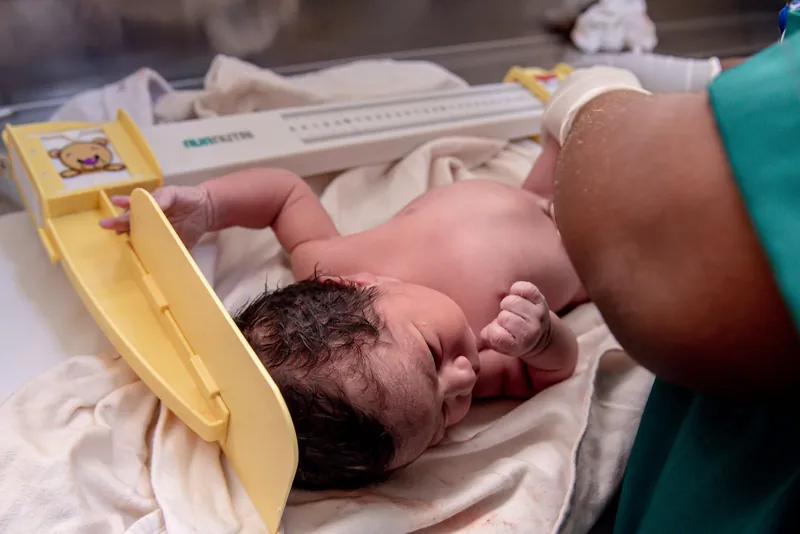
Few numbers worry new parents as much as the one on the pediatric scale. A baby who weighs less on day three than at birth can trigger fear about milk supply, supplementation and “failure to thrive,” even when the loss is expected. Postpartum doulas hear these fears constantly, and the numbers have changed in recent years as large datasets have replaced older rules of thumb. This article explains what current professional guidance and large cohort studies show about typical newborn weight loss and regain, where the sources differ, and what falls inside and outside a doula’s role.
Key takeaways
Quick answer: nearly all newborns lose weight in the first days, most start gaining around day 5, and many are back to birth weight by about two weeks, but a meaningful minority take longer. The decision about whether a particular baby needs evaluation or supplementation belongs to the baby’s clinicians, using the baby’s age in hours, feeding, diapers and overall condition together.
- The American Academy of Pediatrics (AAP) says a well-nourished newborn should lose no more than 8% to 10% of birth weight in the first few days, begin gaining around day 5, and be back at birth weight by about 2 weeks. It adds that almost all babies have regained it by 3 weeks.
- In a study of more than 160,000 newborns at Northern California Kaiser Permanente hospitals, almost 5% of exclusively breastfed babies born vaginally and more than 10% of those born by cesarean had lost 10% or more of birth weight by 48 hours. By 72 hours, more than 25% of the cesarean-born babies had.
- The same research group found that half of newborns were at or above birth weight by 9 days after vaginal birth and 10 days after cesarean birth, and that 14% (vaginal) and 24% (cesarean) were not back at birth weight at 14 days.
- The Academy of Breastfeeding Medicine (ABM) protocol says 10% weight loss is not an automatic marker for the need to supplement but is an indicator for infant evaluation.
What the research says
The traditional rule of thumb. The AAP’s parent-facing pages on HealthyChildren.org give a familiar set of benchmarks. Its page on how to tell if a breastfed baby is getting enough milk says a well-nourished newborn should lose no more than 8% to 10% of birth weight in the first few days before gaining. It lists, for babies 5 to 7 days old, at least 6 wet diapers a day with nearly colorless or pale yellow urine, and at least 3 to 4 yellow, loose stools per day, with the baby seeming satisfied for an average of 1 to 3 hours between feeds and nursing at least 8 to 12 times in 24 hours. It advises a first checkup within 48 hours of hospital discharge, because the weight check will help show whether the baby is getting enough milk. The AAP’s page on the baby’s first month (last updated April 2026) explains that early weight includes excess body fluid that is lost during the first days, that all newborns lose weight during the first 7 days, that steady gain should start around day 5, that most babies are back to birth weight by about 2 weeks, and that growth spurts are typical around 7 to 10 days and again between 3 and 6 weeks. It gives the average gain as almost an ounce (28 grams) per day.
What large datasets show. The 10% line is useful as a prompt for evaluation, but it was never a tidy dividing line between normal and abnormal. Flaherman and colleagues’ 2015 study in Pediatrics used weights recorded during the birth hospitalization for 108,907 exclusively breastfeeding term newborns (83,433 vaginal and 25,474 cesarean births) to build hour-by-hour weight-loss percentile charts. Differences by delivery mode were clear by 6 hours after birth and persisted. At 48 hours, almost 5% of vaginally born and more than 10% of cesarean-born newborns had lost 10% or more of birth weight, and by 72 hours more than 25% of the cesarean group had. The authors proposed that the charts could be used to identify babies on a trajectory for greater weight loss and related complications. The ABM protocol points clinicians to these hour-by-hour charts at newbornweight.org.
The same group followed weights through the first month. Paul and colleagues (2016) analyzed 143,889 newborns and reported that 50% were at or above birth weight by 9 days after vaginal delivery and 10 days after cesarean delivery, while 14% and 5% of vaginally delivered babies were not back to birth weight by 14 and 21 days, and 24% and 8% of cesarean-delivered babies were not back by those times. The authors concluded that it is not uncommon for newborns to be below birth weight 10 to 14 days after delivery. The ABM protocol cites an older figure, an average regain of 8.3 days with 97.5% regained by 21 days. The two sets of numbers are not identical, and the difference is a good reason to speak about ranges rather than a fixed deadline.
What guidance says to do. The ABM’s Clinical Protocol #3 on supplementary feedings (revised 2017) explains that newborns lose weight because of physiologic diuresis of extracellular fluid after the transition to life outside the womb and the passage of meconium. In a prospective cohort in a US Baby-Friendly hospital, mean weight loss of exclusively breastfed infants was 5.5%, and more than 20% of the healthy breastfed infants lost more than 7%. The protocol notes that excess weight loss correlates with positive maternal intrapartum fluid balance (IV fluids) and may not be directly indicative of breastfeeding success or failure. It lists weight loss of 8% to 10% or more on day 5 or later, or loss above the 75th percentile for age, as an indication for careful assessment and possible breastfeeding assistance, and says that weight loss beyond that range may signal inadequate milk transfer or low milk production but needs a thorough evaluation before supplementation is ordered automatically. ABM’s October 2024 position statement on avoiding underfeeding and overfeeding says concerns about neonatal weight loss should be identified early and breastfeeding problems addressed while the need for supplementation is considered, and that overfeeding and medically unnecessary supplementation are often responses to normal parental and infant behaviors. The protocol dates from 2017, so a clinician may be working from newer local policy.

What this means for doulas
- Use ranges and stories, not a single number. “Most babies lose some weight and begin to gain around day five; many are back to birth weight by about two weeks; some take longer, and your pediatrician decides what to do” is accurate against all of the sources above.
- Know why the numbers can shift. Cesarean birth, IV fluids during labor, feeding method and the way a scale is used can change the picture. This is why a doula should not compare one family’s baby with another’s.
- Look at the whole baby, with the parents. Feeds per day, wet and BM diapers, alertness, and the parent’s own observations are the other half of the picture, as the AAP checklist shows. A doula can help a family keep a simple log and bring it to appointments.
- Support milk removal and feeding, not diagnosis. Positioning, responsive feeding, skin-to-skin and a call to a lactation professional are within the scope of a postpartum doula. Deciding that a baby needs formula, donor milk or a particular volume is not.
- Do not turn the scale into a verdict on the parent. Weight loss is often physiology, and ABM notes it may not reflect breastfeeding success or failure. Avoid language that implies fault.
Putting the evidence into practice
- Ask what the care team has said. Find out when the next weight check is and what the pediatric provider or lactation consultant advised. Support that plan.
- Check the early diaper pattern. By 5 to 7 days, the AAP lists at least 6 wet diapers and 3 to 4 yellow, loose stools daily for a breastfed baby. Fewer than that, or dark stools after the milk should have come in, is a reason to call the provider the same day.
- Help parents prepare for the weight check. Suggest that they write down feeds and diapers, note any worries, and ask the provider what weight or range to expect and when to return.
- Stay calm about the first two weeks. A baby who is below birth weight at day 10 but feeding well, with good diapers and clinician follow-up, is within the range seen in large studies. A baby who is sleepy, not waking to feed, or has few diapers needs the provider promptly.
- Refer early. Encourage parents to contact the pediatric provider if the baby is under birth weight at 2 weeks, has not started gaining, or appears dehydrated or very sleepy. See Recognizing Early Signs of Dehydration in Newborns and Recognizing When a Newborn Needs Medical Evaluation: Essential Red Flags for Postpartum Doulas.
Limits and uncertainty
The percentile charts and regain figures come from healthy, term, singleton babies at one health system in Northern California, and the weight-loss charts apply to exclusively breastfed newborns, so they do not describe formula-fed or combination-fed babies, premature babies, twins or babies in other settings. Birth-weight regain data are observational, and weighing practices differ between hospitals. The AAP pages are consumer guidance; the first-month page shows an April 2026 update, while the how-to-tell page carried no update date in the text reviewed. The ABM protocol dates from 2017 and its supplementation thresholds are matters for clinicians, and local hospital policy may differ. This article draws on the full text of the ABM protocol and position statement and the abstracts of the two cohort papers, not their full text. Nothing here is a substitute for a clinician’s assessment of an individual baby.
The bottom line
Newborn weight loss is expected, but how much is expected depends on timing, birth type, feeding and the rest of the picture. Current guidance treats a loss near 10% as a reason to look carefully, not a fixed pass or fail, and large datasets show that many healthy babies take up to two weeks or longer to regain birth weight. A doula adds the most value by helping families feed responsively, keep a clear log, understand the range and call the baby’s provider quickly when the numbers or the baby’s behavior are outside what the care team expects.
Birth & Baby University’s For Doulas page outlines its postpartum doula training, recertification and mentorship for professionals who support families through the newborn weeks. Confirm that any program meets your certifier’s, employer’s or state’s requirements before you enroll.
This article is for professional education. It is not medical, legal or tax advice. Check the standards of your certifying organization and the rules where you work. For concerns about a baby’s health, contact a pediatric provider or emergency services.
Sources and further reading
- American Academy of Pediatrics. How to Tell if Your Breastfed Baby is Getting Enough Milk (HealthyChildren.org). Read the source (read October 2026)
- American Academy of Pediatrics. Your Baby’s First Month: Growth & Physical Appearance (HealthyChildren.org, last updated April 2026). Read the source
- Flaherman VJ, et al. Early weight loss nomograms for exclusively breastfed newborns. Pediatrics (2015). Read the source
- Paul IM, et al. Weight change nomograms for the first month after birth. Pediatrics (2016). Read the source
- Kellams A, et al. ABM Clinical Protocol #3: Supplementary Feedings in the Healthy Term Breastfed Neonate, Revised 2017. Breastfeeding Medicine (2017). Read the source
- Academy of Breastfeeding Medicine. Recommendation for Exclusive Breastfeeding: Avoidance of Underfeeding and Overfeeding (position statement, October 2024). Read the source
More for professionals: the Professionals Blog.



Leave a Reply